Tuesday, December 13, 2011

THE ROLE OF CULTURE IN DEVELOPING A MODERN STATE

Every state in the world is categorized as per factors and levels of development attained. Deveolpment is  not an end factor in itself and there is always room to continuosly improve on the developmental status of a country. This is as a result of constant emerging technology to satisfy ever increasing needs of humans(who make up the state). In essence development is an act in progress at any point in time. Levels of development has culminated in tags such as developed countris, developing countirs and under develoed  countries.
For  a state to develop to modern status means that  state has attained soverenty that is recognized and accepted as one on its own with the responsibity of protecting and acting in the interest of  its citizens and cooperate on such a level with other sister states in areas of mutual interest. Such a state has the absolute right to set up institutions and parameters to maintain law and order and push  the developmental agenda of the state. Put in a more scholarly manner, http://wiki.answers.com describes modern state as one that has organized territory with definite geographical boundaries that are recognized by other states. It has a body of law and institutions of government.

The modern nation state is dependent on the loyalty of citizens. The state offers protection, order, justice, foreign trade, and facilitations of inner state trade in exchange for this loyalty.
The ultimate goal of any modern sate is the quest to push a development agenda forward.  Such developmental agendas are a whole and comprehensive  policy that aims to move the state from one stage to another towards creating a more sound  and fulfilling state for the entire citenzenry.
With the modern state and the need and call to develop now established, the scope of this write-up is thence put into perspective herin that, it will take a compehensive look at the role culture plays in the developmental agenda of a mordern sate preceding the whole discussion with a brief perspective on culture in general terms and hedging it on its importance snd influence on development.
Culture is an embodiment of a people which runs through the  very thread that holds them together. It can also be said that it is the way of life of a particuler group of people who identify with each other. It manifests in several aspects such as the arts, food,dance,costume, language  among others. Cuture is so unique and dynamic to a partuicular group of people.it easily creates a sence of identity and belonginess and is as a result of long standing traditions of practice and socialization.
The Mirriam Webster collegiate dictionary defines culture as  customary beliefs, social forms, and material traits of a racial, religious, or social group; also : the characteristic features of everyday existence (as diversions or a way of life} shared by people in a place or time . This leads to my question that pours open the main hinging point of discussion- ‘how then does culture play a role in the development agenda of a modern sate’?
Local culture provides a sense of identity for rural communities and residents. This identity facilitates common understandings, traditions, and values, all central to the identification of plans of action to improve well-being. Culture contributes to building a sense of local identity and solidarity. It influences the confidence rural communities have for coming together to address specific needs and problems. This local commitment among residents, regardless of economic or political conditions, can serve as a valuable tool in shaping the effectiveness of development options and local actions. Such commitment, based on culture and common identity, can be seen as a potentially important tool in sustaining local government, development, and social improvement efforts.
A very well managed local culture could be very well managed for development in the tourism sector of any modern state. The tourism sector deals excusively with the preservation of culture, its artifacts, infrastructure, food language  etc. Therfore, if these are harnessed well, manageed and incorporated in the development agenda of a state, it will really reap masssive development to aid the overall forward push of the country. This concept has been very much adopted by the kenyans and South Africans to boost their economies and it has a massive impact on their development
Also a keen study of todays changing world and its perculiar developmental needs have given rise to assertions that cultural identities should be a basis for segmentation and teritorial development. This should be in opposition to the conventional government led wholesale development stategy. With the latter, development strategies put in place might not necessarily suit  all sectors. On the other hand if the communities are allowed to spearhead their development as per their cultural perspectives, it will greatly accelrate development and contribute to the complex developmental needs of these times.
Culture should also have a role in creating a national identity as a whole in the development of a nation. Archetectural designs shouls encompaass local artifacts and crats to create a sense of belongingness. National banquets should serve local foods. Local languages should be thought and promoted. Local clothes should be patronized and all these will push the nation forward. The chinese do that and they are on top. The Indians do it and theyare on top. The United States of America and the United Kingdom all do it and they are developing so fast.  All modern states can all do it too.
As i conclude this piece I would like to emphasize that the role of culture in development is enormous and cannot be overlooked if any meaningful progress is to be made in development and the safeguared of national heritage.


Tuesday, December 6, 2011

African viewpoint: Jammeh, Aids and infertility


President Yahya Jammeh (L) speaks with his wife, Zeineb Souma Jammeh, on 24 November 2011 as he leaves a polling station in the capital Banjul
In our series of viewpoints from African journalists, former BBC Focus on Africa deputy editor and Ghanaian government minister Elizabeth Ohene recalls meeting The Gambia's President Yahya Jammeh, who was re-elected last week, after he seized power in a coup in 1994.
As I followed the election news coming out of The Gambia last week, my mind invariably went down memory lane.
It came as no surprise that President Yahya Jammeh was declared winner with 72% of the vote, giving him a fourth five-year term.
Seventeen years ago when Mr Jammeh - then aged 29 - staged a coup that overthrew The Gambia's first President Sir Dawda Jawara, I went to report from the country and I met the fresh-faced young man who sounded like all the other young military men in Africa at the time.

Start Quote

Seventeen years ago he hadn't yet acquired all the titles that are now obligatory adjuncts to his name but he already certainly had illusions of grandeur”
End Quote
Mr Jammeh's inspiration and role-models were Jerry Rawlings of Ghana, Valentine Strasser of Sierra Leone and Muammar Gaddafi of Libya.
I had a memorable interview with him then and again in 1996 when he was under intense diplomatic pressure to return the country to constitutional rule.
I remember he tried to sound confident and even authoritative but every once in a while his nerves failed him.
And last week, when BBC Focus on Africa's Umaru Fofana asked him if he would accept defeat if he lost, Mr Jammeh asked if he looked like a loser, to applause from the crowd around him.
Back in 1996, a few of the friends that he started out with had already fallen out with him and I took a deep breath when someone in the capital, Banjul, told me I should be careful and not think that I was protected by my BBC badge.
'Murders'
A quote from my old notebook reads: "If he thinks you are threatening his position, you will disappear."
I don't remember what I made of that warning but I recall being more amused than frightened by Mr Jammeh's antics.
The post-independence leaders of The Gambia and Guinea, Sir Dawda Jawara (r) and Sekou Toure (R), in this file photo Post-independence leader Dawda Jawara (l) was toppled by Yahya Jammeh
Fast forward to the year 2005, when a group of 44 hapless Ghanaians and nine other West Africans were to experience what happens when the president of The Gambia is perceived to be under threat.
The security forces arrested and killed them, suspecting they were mercenaries when they were, in fact, migrants trying to make their way to Europe.
Mr Jammeh eventually paid $500,000 to Ghana in compensation for those murders.
Seventeen years ago he hadn't yet acquired all the titles that are now obligatory adjuncts to his name but he already certainly had illusions of grandeur.

President Yahya Jammeh

  • Overthrew The Gambia's first president as a 29-year-old army lieutenant in 1994
  • Has won four widely criticised elections
  • Accused of not tolerating opposition or independent journalists
  • Claims he can cure Aids and infertility with herbal concoctions
  • Warned in 2008 that gay people would be beheaded
  • Eight men sentenced to death last year after being accused of plotting to overthrow him
You had to be blind not to see that he would be better for The Gambia than Mr Jawara was, Mr Jammeh told me.
His belief that The Gambia has achieved more during his 17 years in office then during 400 years of British rule must have occurred to him later.
When I heard Umaru's interview with him, he came across as unabashed, unapologetic and indeed quite proud to say that The Gambia was "hell for journalists" - even in those early days journalists were not his favourite people and some learnt the hard way not to upset the young leader.
The bit I couldn't have predicted was Jammeh the healer. Not only did he announce in 2007 that he had discovered a herbal cure for HIV/Aids, he now has a cure for infertility as well.
The government's official website carries reports of barren women being kept in villages for the president's wonder cure.
Aged 46 and with no apparent likelihood of Gambians being tempted to lose their marbles at polling booths, the chances are His Excellency Sheikh, Professor, Alhaji, Doctor Yahya AJJ Jammeh will be around for a long time as President and Commander in Chief of the Republic of The Gambia.
The Arab Spring might find it difficult to cross the Sahara desert.
In West Africa, our weather pattern does not include spring - we have only dry and rainy seasons.
I only wish I had the opportunity to interview him again. I suspect he won't talk to me now.


RECORDED BY ME OF ELIZABETH OHENE(former government minister) for the BBC WORLD SERVICE

Sunday, November 27, 2011

MY TAKE ON LIBYA and the arab revolutionary world

HARLOW’S PUBLIC RELATIONS DEFINITION AND WHAT IT IS


Rex Harlow, considered by many in the public relations world as one of the best things to happen to the profession defines
Public relations as the distinctive management function which helps establish and maintain mutual lines of communication, understanding, acceptance and cooperation between an organization and its publics; involves the management of problems or issues; helps management to keep informed on and responsive to public opinion; defines and emphasizes the responsibility of management to serve the public interest; helps management keep abreast of and effectively utilize change, serving as an early warning system to help anticipate trends; and uses research and sound and ethical communication as its principal tools. (CCB, p.4, Harlow)

Critiquing and relating this definition to what public relations is all about, words such as distinctive, management function, establish, maintain, and mutual will be interrogated in the perspective of Public relations..

As per the definition, the word distinctive goes to give credence to the fact that Public relations even though correlates with other fields, it stands out because its core and nature is like no other of the allied professions.

Public relations as a management function as in Harlow’s definition and any other public relations template shows that public relations should be embedded in the management of a company without hindrance from any bureaucracy whether internal or external. The public relations department should have direct input in the management of the company.

Picking on “establish and maintain”; These  words lay importance to the fact that public relations people need to create relationships and go on to keep them intact for the benefit of the organization and its publics which is a mutual stand.

Zooming into what public relations is all about, it is the conscious creation of a mutually beneficial relationship between an organization and its publics for a two way continuous flow of information.


Saturday, November 26, 2011

ADINKRA- IMPORTANT COMMUNICATION TOOLS


Communication is the sending and otherwise receipt of messages (information) from an identified source to a receiver for shared meaning to be attained. By virtue of this blanket definition, communication is an everyday occurrence as human existence cannot operate in a vacuum.

The more people keep interacting with each other and expect to gain responses to inform their actions, communication is said to occur.

Put in a more scholarly context, http://en.wikipedia.org/wiki/ defines communication as the activity of conveying meaningful information. Communication requires a sender, a message, and an intended recipient, although the receiver need not be present or aware of the sender's intent to communicate at the time of communication; thus communication can occur across vast distances in time and space. Communication requires that the communicating parties share an area of communicative commonality. The communication process is complete once the receiver has understood the message of the sender.

The adinkra symbols are very perculiar. They are visual symbols that originated from the asante people of ghana and also the Gyaman of Cote d'Ivoire in West Africa. These symbols have been (and still) used to represent concepts and convey messages.

Adinkra are used extensively in fabrics, pottery, logos and advertising. They are also incorporated into walls and other architectural feature
As the ultimate aim of communication is to convey  messages and attain a shared meaning, Adinkra symbols can be classified as an important tool of communication.
These symbols are employed a lot by large outdoor advertisers to send out clear cut messages to their target audiences. For example in ghana, Vodafone ( a multinational moble phone Company) uses a lot of adinkra symbols in their outdoor advertising just to

convey the message that they share the ghanaian values of their local customers.  Also huge achetectural buildings incorporate them in their designs not only to convey a message of beauty but to convey a message of being indegenous.
Adinkra symbols such as Gye Nyame, Sankofa, owuo akwedie are also used in the fashion industry,religion and culture. In the fashion industry these symbols are inscribed on cloths to convey specific messages. For example the ‘Gye Nyame’ which means except God  symbolises the wearer’s believe in the supremacy of God.  It is also common to see ‘Owuo akwedie’ (death ladder) imprinted on  funeral cloths just to send the message that every human being will one day climb the ladder of death.
In culture, they are used as symbols of greatness and identity of clans and other groupings. By their very nature, they convey instant messages and are a great tool of communication. The very word ‘NKRA’  that holds the word ‘adinkra’ together means ‘message’ so it is by no accident that it is a very important communications tool.


BACP2014022


Saturday, May 21, 2011

THE REVOLUTION AND DEMOCRATIC PARTICIPANT MEDIA THEORIES


AS PRESENTED BY


LEVEL 100 MASS COMMUNICATION CLASS                 GROUP SIX

MEMBERS
OSEI WIREKOAA IRENE……………BACJ2014062
MUSTAPHA SAFIA…………..BACP2014027
MPARE RITA OHENEWA ……..BACJ2014053
LANSAH SULLEY………………..BACP2014022
This presentation will take a look at the revolutionary media theory as well as the democratic participant theory, bringing out their nature and strengths.
 Revolutionary concept is a normative theory describing a system in which media are used in the service of a revolution. A revolution is described as a popular uprising against an existing system. There have been revolutions all over the world and the type of media that served under such revolutions give credence to the revolutionary media theory. We will like establish the context that every media theory has a bearing of the political system under which it thrives therefore we proceed to give examples of revolutionary media theories and how they pan out with emphasis on the soviet communist theory.
The soviet –communist theory is an example of  a revolutionary theory. To understand the nature of this media theory, one needs to understand soviet communism as a political system because of  it’s influences on the media .
The Merriam-Webster’s Collegiate Dictionary defined Communism as   a theory advocating elimination of private property. It goes on further to explain a system in which goods are owned in common and are available to all as needed
 a doctrine based on revolutionary Marxian socialism and Marxism-Leninism that was the official ideology of the USSR. it is also important to  explain Maxism.
Marxism was defined by the same source as the political, economic and social principles and policies advocated by Marx, especially a theory and practice of socialism including the labor theory of value, dialectical materialism, the class struggle and dictatorship of the proletariat until the establishment of a classless society. Marxism-Leninism was defined as a theory and practice of Communism developed by Lenin from the doctrines of Marx. 
With this system, the state is the authority that redistributes all resources equally for the citizens to benefits. Resources such as healthcare, education and information are all the preserve of the government.
 In the former Soviet Union, a single political party controlled the government, which in turn controlled the goods and means of production, and thus distributed them to the proletariat, or community.
  The person who used Marxs ideas to establish a state based on Communism was Vladimir Lenin.  Lenin felt the working class could not bring about a revolution and thus needed a professional group of revolutionaries to guide it. Lenin and the Bolsheviks (Majorityists) came to power in 1917 and changed their name to the Communist Party. A dictatorship was established to convert the Soviet Union from Capitalism to Socialism (Britannica Online). 
 Lenin’s successor, Joseph Stalin, forcibly accomplished the transition from Capitalism to Socialism through the nationalization of industry and the collectivization of agriculture. Stalin pushed rapid industrialization although it caused great material hardship. He also used police terror to suppress opposition (Britannica Online). 
 Communism spread after World War II, when the victorious Soviet Red Army liberated and sponsored the formation of Communist governments in Bulgaria, Czechoslovakia, East Germany, Hungary, Poland, Romania and North Korea. Other independent communist regimes were created in Yugoslavia and Albania. Stalinism, Stalin’s form of Communist rule, became the model for these newly formed Communist governments (Britannica Online). 
This is the system under which the soviet communist media theory thrived. This theory is derived from the ideologies of Marx and Engel that "the ideas of the ruling classes are the ruling ideas". It was thought that the entire mass media was saturated with bourgeois ideology. Lenin thought of private ownership as being incompatible with freedom of press and that modern technological means of information must be controlled for enjoying effective freedom of press.
The theory advocated that the sole purpose of mass media was to educate the great masses of workers and not to give out information. The public was encouraged to give feedback as it was the only way the media would be able to cater to its interests.
 Mickiewicz (1988) found that the media in the Soviet Union had distinctive and officially prescribed functions.  The primary mission of the media, according to Mickiewicz, was the socialization of the person receiving the message. So, the media were educators, just as schools, the courts of law, the family and other institutions of education. In the Soviet Union, Mickiewicz found that education was the primary mission for all of these aforementioned institutions because they have a delegated authority from the state to socialize and educate according to the established criterion (p. 27). The source of this authority dates back to Lenin and his premature revolution according to orthodox Marxist theory. Marx believed the revolution would occur when the proletariat was in a state of commonality, when common social bonds united them, eliminating deviance, dissatisfaction, selfishness and acquisitiveness. Since Lenin’s revolution occurred before this state of commonality of the proletariat, Lenin believed the changes in the popular mentality had to be changed from a higher authority, and thus the imposition of a delegated authority to socialize and educate (Mickiewicz, p. 27). 
 The media had several functions in the USSR One function was to integrate the expansive, multi-lingual country that was to be the first socialist state. Overall, the medias task had two principal dimensions, according to Mickiewicz. First, the media had to change the ethical and moral outlook of the population. She said of this dimension: The psychological orientation underlying the society of the future, when full communism has been achieved, requires cooperation and collectivism and eschews selfishness, careerism, greed, and, in general, the development of an individual that might supersede the societal collective (p. 28). The second dimension of the medias task was to rouse the population to contribute to the economic goals of the state. Thus, mobilizing the population to meet production goals became a critical role of Soviet media (Mickiewicz, p. 28). The media were used to mobilize the public to achieve the goals of the state: Communism would only be met when the population’s internal value system had changed within a context of enhanced economic production. 
 In Soviet terms, newsworthiness was something very different from the Western concept of what is newsworthy. Many Western stories were considered inappropriate covering domestic natural disasters, accidents, crime or other sensational events were considered dwelling on negative events. Thus, portraying the underside of life would encourage or suggest the wrong behavior, undermining the positive role models the newspaper or television station must portray in terms of their role as educators of the population (Mickiewicz, p. 29). 
 Advertising is scarce in the Soviet media system, used only to supplement policy messages or to encourage buying patterns to compensate for holes in the economy (Mickiewicz, p. 29). Fast-breaking news also had another meaning. The importance or newsworthiness of fast-breaking news was evaluated in terms of its place in history, in Marxist-Leninist history. Therefore, since history was seen according to this doctrine, coverage of a numerically insignificant group of demonstrators opposing a bourgeois government may have been considered newsworthy because it was important in terms of Marxist-Leninist history theory (Mickiewicz, p. 30). In essence the soviet communist system has some semblance of the authoritarian press system but the unique thing is that there is no element of profit in its operation.                   

Any real revolution involves masses of people breaking with the general ideas they have been brought up with and adopting a new way of seeing both the world and their own role within it. Revolutionaries always begin as minorities attempting to propagate the new world view. And that involves, for long periods of time, not only hostility from the old ruling class, but also indifference from many of the members of the oppressed class. There is no way to avoid this period of unpopularity, since in any society the ruling class does dominate ideologically. Its ideas are indeed the ruling ideas.
Revolutionaries cannot begin to win this battle for ideas unless they find some way of connecting with the experiences of the mass of ‘ordinary’ ‘non-political’ people. They have to be able to show that the revolutionary view of the world better fits with at least some of these experiences in a better way than does the dominant ideology.
But revolutionaries are not interested simply in winning people to new ideas. They also have to be concerned with getting people to act on the basis of these, to say not merely what is wrong, but also, above all, what is to be done. That is where the media comes in
Talk of the media under the Jerry Rawlings regime, the Quadaffi regime, the Hugo Chavez regime, the French revolution and the like. They all have the same concepts. As such their advantages are binding.
ADVANTAGES OF THE REVOLUTIONARY MEDIA THEORY
·         THE MEDIA IS A STRONG RALLYING POINT TO EDUCATE THE MASSES
·         THE GOVERNMENT EXERCISES CONTROL TO GET ITS MESSAGE TO THE MASSES THE WAY IT WANTS IT
·         THE GOVERNMENT IS ABLE TO INSTILL CHANGE IN THE PEOPLE THROUGH THE MEDIA
·         VALUES SUCH AS PATRIOTISM CAN EASILY BE INSTILLED IN THE MASSES FOR NATIONAL DEVELOPMENT.
·         THE GOVERNMENT FINDS A WAY OF CURBING INTRUDING PROPAGANDA BECAUSE IT CONTROLS THE MEDIA CONTENT.
·         THE MEDIA IS A MASSIVE TOOL FOR CAPACITY BUILDING AND DISSEMINATION OF GOVERNMENT POLICY AND IMPLEMENTATION ESPECIALLY UNDER THE SOVIET COMMUNIST THEORY.

DEMOCRATIC PARTICIPANT MEDIA THEORY
Democratic-participant theory was proposed in recognition of new media developments and of increasing criticism of the dominance of the main mass media by private or public monopolies. From the 1960’s onwards call could be heard for alternative, grass-roots media, expressing the needs of citizens. The theory supports the right to relevant local information, the right to answer back and the right to use the new means of communication for interaction and social action in small-scale settings of community, interest groups or subculture. This theory challenged the necessity for and desirability of uniform, centralized, high-cost, commercialized, professionalized or state-controlled media. In their place should be encouraged multiple, small-scale, local, non-institutional, committed media which link senders to receivers and also favor horizontal patterns of interaction.
Practical expressions of the theory
The practical expressions of the theory are many and varied, including the underground or alternative press, community cable television, micro-media in rural settings, wall posters Media for women and ethnic minorities. The theory reflects the market as a suitable institutional form, as well as all top-down professional provision and control. Participation and interaction are key concepts.
Democratic-participant theory advocates media support for cultural pluralism at a grass-root level. Media are to be used to stimulate and empower pluralistic groups. Unlike social responsibility theory, which assumes that mass media can perform this function, democratic-participant theory call for development of innovative, ‘small’ media that can be directly controlled by group members. If they cannot afford such media, then government subsidies should be provided to them existing small media should by identified and funded. Training programs should be established to teach group members how to operate small media.
The democratic participant media is the type of media practiced in Ghana today with the freedom to the press. It is also very common for media outlets to make provision for their audience to have a say in their content through emailing phone-ins or articles. Media houses like TV3,Metro TV, The Graphic among others all operate in this way. The chief proponents of this theory however is the  United states of America and The United Kingdom, the home of CNN and BBC
STRENGTHS OF DEMOCRATIC PARTICIPANT THEORY

·         THE TARGET AUDIENCE HAVE AN OPPORTUNITY TO MAKE THEIR VIEWS HEARD
·         THE TARGET AUDIENCE HAVE THE RIGHT TO ALTERNATIVE NEWS SOURCES
·         IT ADDRESSES THE INADEQUACIES OF THE AUTHORITARIAN AND LIBERTARIAN THEORIES
·         IT HELPS ELIMINATE MARGINALIZATION AS ALL PERSONS ARE GIVEN EQUAL ACCESS TO THE MEDIA.
·         MEDIA IS THE INSTRUMENT TO CHAMPION DEMOCRACY
·         IT PROMOTES SMALL GROUP MEDIA


BIBLIOGRAPHY
Communism. Britannica Online [On-line], Available: http://www.eb.com:180/cgi-bin/g?DocF=micro/138/32.html
 Communism Online [On-line], Available: http://wgel.com/CommunismOnline/MajorPlayers.htm. 

Marxism. Britannica Online [On-line], Available: http://www.eb.com:180/cgi-bin/g?DocF=micro/379/14.html.

Mickeiwicz, E. (1988). Split Signals: Television and Politics in the Soviet Union. New York: Oxford University Press.
 http://www.slideshare.net/ArielForeman/normative-theory-2225358


Wednesday, May 18, 2011

SIMA'S ASSETS TO BE CONFISCATED

The Narcotic Control Board (NACOB) says it is in the process of confiscating the property of convicted fashion Icon, Ibrahim Sima.

The Board said the former boss of EXOPA Modeling Agency’s belongings, when confiscated will not be given to the state instead be sold to the public.

The acting Executive Director of NACOB, Yaw Akrasi Sarpong who confirmed this to Citi News in an interview said, this move will help prevent some individuals linked to Mr Sima from sponsoring him while in prison.

He disclosed that there is a trend emerging where drug barons do not care going to prison because they have undisclosed wealth with which they get catered for while in incarceration.

“Everyday you have about hundred people who have worked with couriers, they are not bothered because when they go to prison the barons look after them and in the case of Ghana in particular where the legal space is common law jurisdiction, there is a lot of avenues of people to be defended.

“Starting from the Ibrahim Sima case, recently we published a list of all his assets that we know, if nobody claims ownership to those assets we will start a process of confiscating them and when we confiscate them we will not give them to the state we will sell them out”.

Ibrahim Sima was jailed for 15 years for a narcotic offence in March 2011. He is currently undergoing psycho-counselling at the prison's diagnostic centre to help him settle in his new environment.

Monday, May 16, 2011

Secret Tape says ¢9million for Mills, not ¢90m

Secret Tape says ¢9million for Mills, not ¢90m
 

Herbert Mensah
The controversial security tapes supposedly recorded by security personnel attached to the Osu Castle, which have generated hullabaloo in the media and political landscape in the past days, have revealed that ¢90 billion (GH¢9million) will be used as campaign money for President Mills’ re-election bid and not GH¢90 million as was put out in the media domain.

DAILY GUIDE on Sunday May 15, listened to nine minutes of a recorded conversation, believed to be two hours long, during which the voice of a man who claims to have connections with the Castle said that 90 billion old cedis had been allocated by President Atta Mills’ team for the campaign to get the president re-elected as National Democratic Congress (NDC) flag-bearer.

Herbert Mensah, businessman and an aide to former President Jerry John Rawlings, had told Peace Fm that the ¢90 billion was mentioned on the tape to have been allocated for each of the ten regions in the country for the Mills campaign, which amounts to a colossal GH¢90 million.

President Mills has denied ever sanctioning GH¢90m, equivalent to $60 million, for his campaign and even asked the security agencies to investigate the matter for Ghanaians to know the truth.

The President said, “Where I have reached in my career, it is not the time for me to disgrace myself. I have therefore ordered our security agencies to conduct investigations into the allegation so that Ghanaians would know the truth.”

The identity of the voice on the tape was not clear, but he mentioned that he is a researcher who is usually engaged by top politicians to embark on research for them during electioneering periods.

He noted on the tape that the President Mills campaign team planned to allocate ¢30billion out of the ¢90billion to campaign in the Ashanti region alone, in anticipation of winning more votes from the region.

The voice also named four close aides and deputy ministers in the Mills administration, Baba Jamal, Koku Anyidoho, Alex Segbefia and Nii Lantey Vanderpuye, as well as three other people from the Ashanti region who have been tasked to embark on a ‘special operation’ for the Mills’ campaign.

The three people from the Ashanti region who were named on the tape include KMA Boss Samuel Sarpong, NDC Ashanti Regional chairman, Yaw Obimpeh and one Mr. Owusu who is said to be a staunch member of the party.

The ‘special job’ that the seven-member campaign team has been tasked to perform for the president’s re-election campaign bid was not explained on the controversial tape.

Herbert Mensah, a close associate of the Rawlingses who made the claim of the existence of the ‘security tape’ in a radio interview last week, has so far not released the tape to any media house but DAILY GUIDE learnt that some radio stations might play it this morning.

DAILY GUIDE approached him over the weekend for a copy of the tape which is now the major topic in town but he declined to make copies of it available. However, a reporter was allowed to listen to nine minutes of what they said were excerpts of the over two-hour recorded tape.

The person whose voice is on the tape said he is a researcher and that a security person at the Castle, the seat of government, who was present at those meetings informed him about the president’s campaign funding.

DAILY GUIDE has since then spoken to some delegates of the NDC in the Ashanti region who have confirmed that President Mills’ team wants to use money to induce delegates for votes.

A leading member of the party who demanded anonymity hinted that NDC National Women’s Organizer, Anita De-Sousou, recently promised that government would in June make available ¢200million loans available to all the 39 constituency women’s organizers in the Ashanti region.

Madam De Sousou was also reported to have promised an additional ¢100 million loan package for the deputy women’s organizers in the region.

Anita has denied making any such promise to the women organizers when contacted by DAILY GUIDE, saying, “I am sorry I don’t know anything about that story; I am sorry I don’t have an idea about that money.”

BNI Storms Adom Fm
In a related development, the premises of Adom FM was raided by BNI operatives last Friday when the station announced that copies of the controversial tape would play on air today.

Sources said the BNI’s move was ostensibly to prevent the station from playing the tape. A courier who was allegedly on his way to Adom FM to deliver the tape disappeared upon seeing a BNI operative.

The man, who had apparently been tasked to deliver the recording to Adom FM to enable Adakabre to air the recording on Monday, on his arrival became aware of the presence of BNI officers at the station.

Following a series of highly-publicized events, the BNI stormed the offices of Adom FM on Friday morning, ostensibly to prevent tapes suggesting financial and physical intimidation on the part of persons close to or a part of the President’s re-election team from being played.

On Friday morning, after announcements referring to the tape, the BNI stormed Adom Fm’s offices. Staff were alarmed as the BNI officers entered aggressively, with panicked and stressed faces.

A staff of Adom Fm was reported to have said, “They thought we already had the tape so they wanted to come for it.”

Ronaldo Hits 50-Goal Milestone

Cristiano Ronaldo has joined an elite group of players to have scored 50 goals in a single European season when he netted twice for Real Madrid on Sunday evening in a 3-1 win over Villarreal at El Madrigal in the Primera Division.

The Portugal international attacker recorded his milestone 50th goal on 22 minutes with a trademark freekick, rifling in a dipping, curling shot from 20 yards out to give his side a 2-0 lead over the Yellow Submarine. He repeated the trick four minutes into injury time, scoring an almost identical freekick to notch up his 51st of the season in all competitions.

It ensured that he became only the second player in Spanish football history to break the 50-goal-a-season mark. His close rival, Barcelona forward Lionel Messi was the first when he reached the landmark on April 23, 2011 against Osasuna.

It was also Ronaldo’s 37th and 38th goals in La Liga this campaign, allowing him to equal the record number of goals scored in the league in one season. With just one more round left to play, CR7 can now break Telmo Zarra and Hugo Sanchez’s record of 38 league goals in a single term.

The Mexican legendary striker scored that many goals in 1989-1990 while featuring for Madrid, equalling the feat set by Zarra for Athletic Bilbao in 1950-51.

However, Zarra scored 38 goals in 30 matches at the time and although Ronaldo could well break this record with Madrid to host Almeria at the Santiago Bernabeu next week, he would fail on games to goals ratio. Nevertheless, the 26-year-old has already bettered the accomplishment of Brazilian legend Ronaldo (47), Zarra (48) and Hungary's Ferenc Puskas (49).

Spio Garbrah Hits Town…Informs JJ About Decision To Contest Tuesday

An aide to Dr. Ekwow Spio Gabrah, Alhaji Mohammed Nasiru has disclosed that Dr Spio Garbrah will be meeting former President Jerry John Rawlings on Tuesday afternoon to formerly inform him of his decision to contest for the position of flagbearer in the upcoming National delegates Congress in July to be held in Sunyani in the Brong Ahafo Region.

In an exclusive interview with the news desk of X-FM, Ahaji Nasiru further stated the meeting will also be used by Dr. Spio-Garbrah to announce his arrival into the country as well as give other details about the formal launch of his campaign and other matters arising.

Dr. Garbrah, a leading member of the ruling National Democratic Congress (NDC) stunned party followers and political pundits when he declared his intention to contest the flagbearship slot of the NDC which hitherto was a close fight between former first lady Nana Konadu Agyemang Rawlings and incumbent President John Mills by announcing his resignation as a vice chairman of the party.

Most party followers especially from Mrs. Rawlings’ camp believe Dr. Garbrah’s participation will be a blow to the former first lady’s bid since he has been seen in political arena as an associate of the former first family.

But others also believe, it is to introduce himself and announce to potential delegates about his desire to contest for the leadership position of the party in 2016, and might probably resign at the final stages of the delegates’ congress at Sunyani.

This will be the second time the former Minister of Communications and C.E.O. of Commonwealth Telecommunications Organization (CTO) based in London will be vying for the leadership slot of the NDC after an abysmal performance against the then Candidate Mills in 2006.

ATTA MILLS MAGIC RING EXPOSED

ATTA MILLS MAGIC RING EXPOSED

Sunday, May 15, 2011

SPURS MOVE ON

Liverpool 0-2 Tottenham: Van der Vaart & Modric silence the Dalglish revolution as Spurs leapfrog Reds into fifth

Tottenham is once again in control of a place in Europe after topping Liverpool and jumping up to fifth in table, just in front of the the Reds

By Steve Hewlett

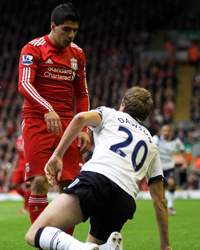
EPL,Michael Dawson, Luis Suarez,Liverpool vs Tottenham Hotspur
Photo Gallery
Zoom
EPL,Michael Dawson, Luis Suarez,Liverpool vs Tottenham Hotspur

Related Links

Teams

Tottenham has put itself into the driving seat for Europa League qualification as it defeated Liverpool at Anfield with goals from Rafael van der Vaart and a controversial penalty which was scored by Luka Modric. The result sees Harry Redknapp’s side move above Liverpool into fifth in the Premier League and means it goes into the final round of games next Sunday with the advantage in the race for European football next season.

Spurs scored in both halves in a game which frustrated the Anfield faithful and put the brakes on the Dalglish lead revival. The result is the perfect pick-me-up for Spurs after the defeat to FA Cup winners Manchester City last Tuesday killed off Tottenham’s hopes for a second campaign in the Champions League.

The mirror image can be said of Liverpool which after scoring five past Fulham in its last outing, was kept at bay by the visitors from north London.

Anfield is a bogey ground for Tottenham. The last victory was way back in 1998 when Spurs won a League cup game 3-1. The current groups of Spurs players would be unaware of this fact and these doubts were quickly expelled as the visitors found themselves in the lead in under 10 minutes. A Luka Modric corner was cleared from the danger area where Rafael van der Vaart picked up the loose ball and let rip with a powerful lob which flew beyond Pepe Reina and into the top left of the Liverpool net. An excellent start for any team away from home.

The first half produced very little for the Liverpool fans to cheer. The Reds struggled to build any tempo in their attacks and this wasn’t helped by referee Howard Webb. The World Cup final ref made a number of calls which infuriated Anfield. One of note was the decision to book Luis Suarez after the striker kicked out with petulance at Tottenham captain Michael Dawson. The Uruguayan challenged the center half and felt Dawson fell too easily and responded with a gentle kick which Webb punished with yellow.

It was hard to believe that this was the same Liverpool outfit which was scoring at will against Fulham on Monday evening and Kenny Dalglish was visibly frustrated on the bench at what was playing out on the rain sodden pitch.

Liverpool did improve as the half progressed and began to establish an impact on affairs and chances did finally materialize. Young Jay Spearing saw his shot from within the box fly wide right but the best opportunity to level the score fell to Andy Carroll. An overlapping run from the defender, Martin Skrtel was finished with a looping cross to the far post where an unmarked Carroll headed over. The £35million pound held his pony-tailed head in his hands as he failed to even hit the target from such close range.

Carroll’s slaloming run at the end of the half was halted by Sandro and the resulting free kick by Suarez, which flew narrowly wide, was the last of the half and gave the Reds confidence that parity was within touching distance as they returned to the dressing rooms.

The second half begun as the first did, with an early Tottenham goal. A jinking run from Steven Pienaar was abruptly stopped when John Flanangan shoulder charged the former Everton winger and he tumbled to the turf. On first sight it appeared to be a harsh penalty as Flanagan was side-by-side with the South African when he made the challenge. Regardless, Webb pointed to the spot and Luka Modric hammered home to double the lead. The mood in Anfield turned even more sour.

Tottenham didn’t have everything its own way as goalscorer van der Vaart was replaced with Jermain Defoe after injury. Not what Redknapp would have wanted going into next Sunday.

The game continued in much the same fashion, a great deal of huff and puff from Liverpool but no real sense that the goal would ever come. Tottenham was content to hold up the ball and play for time.

Both sides enter the final round of games next week with everything to play for. Liverpool travels to former manager Gerard Houllier's Aston Villa hoping for a favor from the old boss. Spurs host Birmingham City, which also needs the points in the battle against the drop to the Championship. An interesting week awaits.
CREDIT.......goal.com

Friday, May 13, 2011

A NEW AWAKENING

This is your one stop market to feed your mind.............WATCH OUT......please do visit my blog again